Dialing In: Eyeline
Something you'll notice about powerlifters is they don't all agree on many things. One thing for certain they do agree on, is the emphasis and power of a strong eyeline. Whether they look straight ahead, down on the floor (usually 6-10 feet out ahead of themselves), or just merely look up towards the sky as hard as they can, from what I notice, they all do it.
Eyeline becomes a dogma, as do almost all the particulars when mastering one lift. In my days spent training with Garage Ink powerlifting, it was one of the most emphasized factors. Niko Hulslander, owner and head coach, told me my first time in his gym, “We don't have mirrors,” and it was for a strong reason. He then went on to say that when he's had to squat in front of mirrors, he would place a sticker, typically straight ahead, to look at. He wasn't specific about it needing to be one spot, and he wanted us to figure out what worked best. For myself, at the time, I was reading a lot of Mark Rippetoe articles on looking more downward. It seemed to feel better on my neck, although I no longer use this style. I would place a 2.5 pound plate 6 feet out in front of me on the floor. That was my thing. It better not be a dumbbell, and no, I can't look at a spot on a bench; I looked at a 2 and a half pound plate. At meets, I made an exception. My teammates would place a water bottle by the head judge centered in front of the bar. That was my thing. This is what we all did. We had our own way, but eyeline was a must.
Since my time there, I've explored many things. In yoga, we would set our eyes on one spot called drishti. This refers to setting your gaze to a specific spot on the wall to help center the mind and body. Immediately, meditative balance! I also heard talk of only unlocking the true yoga from a flow once it could be done with the eyes closed or blindfolded, which is ironically an eye-opening experience.
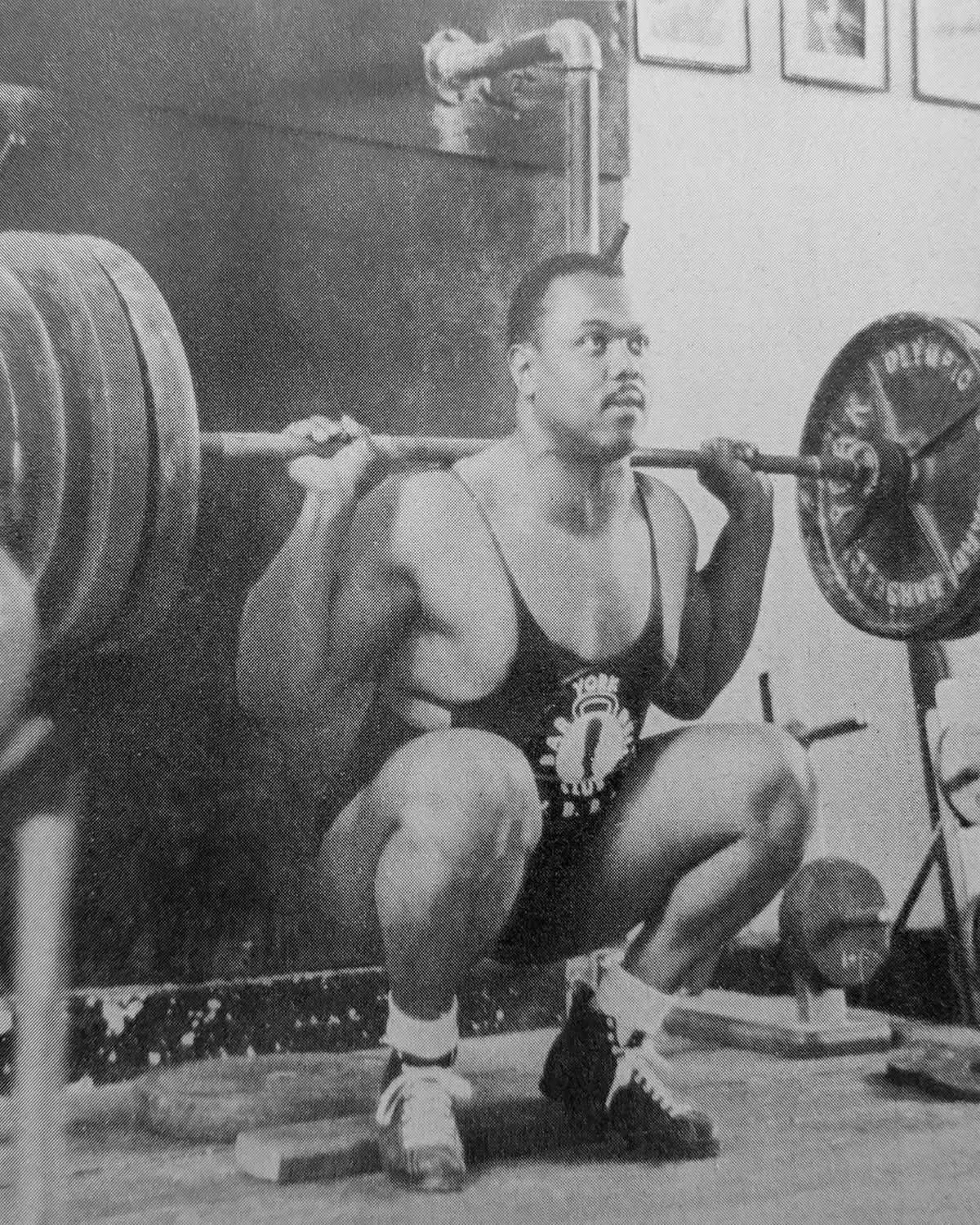
Weightlifter John Davis squatting with his eyes straight ahead
This later came up with my mentor James Fuller talking about performing lifts with his eyes closed to make sure he truly knew the lift. He mentioned doing snatches, eyes closed. Let me tell you, until you try this, eyes closed, internal, you cannot comprehend what it is like. I sometimes end my workouts standing on an upside-down bosu ball or even a standing meditation on the ground. No matter how effortlessly I can balance, the second I close my eyes, I enter a different world.
Proprioception refers to the body's ability to sense its position in space and control its movements without consciously looking. I like to think of it as calibrating a video game controller. Back in my youth, I recall turning on a video game console while the directional pad or joystick was pushed towards the left. This would make all controls for the game push towards the left. Even if you held the direction up, you would move up and to the left. I imagine all of us having some margin of misalignment between our sense of movement and the way we actually move. Perhaps we are only slightly off and seemingly insignificant for day-to-day recognition, but a part of me thinks this is a constant state of war going on within ourselves and with the world around us. My thoughts are a bit extreme, but I do think there is something there.
I recall early on in my lifting hearing of seminars on strength involving rolling your eyes up, down, or to the side to ignite different forces in the nervous system. I never got too into it, but it made sense. And when practiced, I could feel it. Rolling the eyes up engaged the posterior chain on a deadlift. I did not like the need to roll my eyes up into the back of my head every time I wanted to promote posterior engagement or look to the left to do a bicep curl. I’m weird enough.
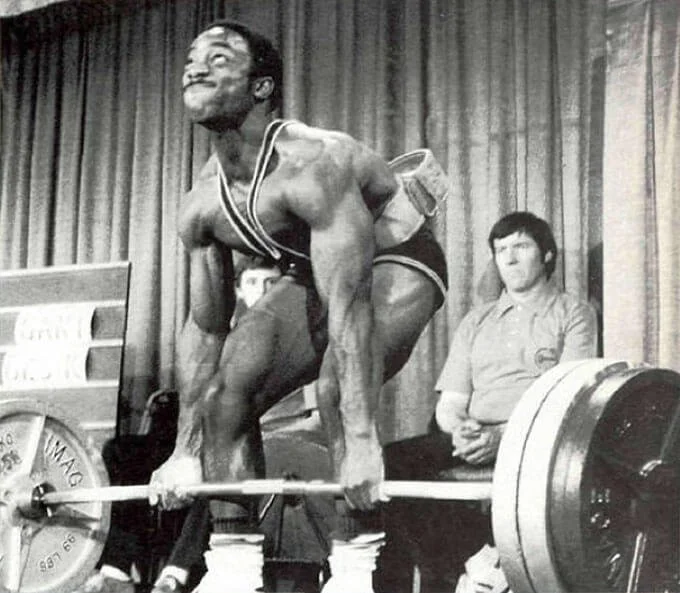
Powerlifter Lamar Gant deadlifting with his eyes looking up as high as he can
But I see it. I hear it. “Up up up up!!!” they yell. “Look up!” Whether you think it is wrong or right, so many of the best do it. Have we ever seen an Olympic lifter look up right before the first pull or come out of the hole to squat the weight up? In a vertically explosive sport like weightlifting (cleans, snatches, even jerks), it makes sense. When you're young and strong, it's nothing to look up. When you're old and weak, it becomes harder. Gravity breaks us down.
There's also the concept of maintaining a neutral eyeline that stays relative to the body angle, straight out ahead, and never fixed to one spot. Dizzying! This seems to work well on higher rep or extreme spinal angle changes like kettlebell swings or good mornings. Dan Cenidoza, owner of my current gym, Baltimore Kettlebell Club, watches the bell in get-ups, and looks up to overhead press. He also recommends looking at the horizon or straight ahead and at times, maintaining neutrality (eye angle stays fixed to the angle of the body as it moves.) All of these concepts are ones I have heard, but it is refreshing Dan uses variability and reasoning between the lifts. Probably my favorite “ah-ha!” moment from Dan on this topic was when he told me he used eyeline to correct the posture breakdown of a senior client. During lifts, he would increase the eyeline height over the span of months to help a client be able to lift their head at a normal gaze. It worked! Imagine that.
The idea of keeping your eyes on the weight is a fascinating one. While watching the bar as it moves might be less ideal in a deadlift, I can see how when pressing, it might be the strongest. But doing this with any lift, even if the result is weaker, will unlock some new element of understanding that can only be obtained through practice. What is it to look at a kettlebell as it swings, or clean into a press? What does this do? What does this lock you into? How is it different? Are you connecting yourself to the implement you are lifting or moving more fluidly? And, if it doesn’t yield long-term benefits, are you any worse off for experimenting? This curiosity and experimentation is exactly what I look to unlock in others. For me, in the bench press, I can recall watching the bar lower to the exact spot it was going to hit on my chest and following it as it tracked up, witnessing any imbalance or sticking point in order to drive through. This is what I learned to do benching in a gym that’s ceiling had insanely bright lights right above the bench that hurt my eyes, so I watched the bar instead.
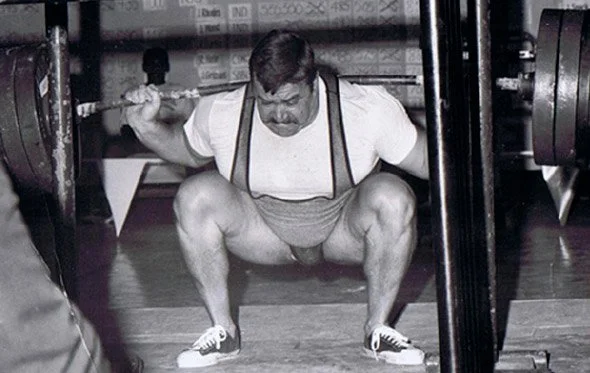
Powerlifter Hugh Cassidy squatting looking at a spot on the floor
In striking, and as I'm realizing in grappling (it took me until being a black belt to even consider), it can be so empowering to set an eyeline. In boxing, maybe the chest. In kickboxing, maybe the lower belly. Boy, does this tighten up your game and center you! You go from looking like a noob to actually looking of strong intention and quality merely from tunneling in on a spot! The last jiu-jitsu match I had, I did not take my eyes off my opponent, even as he walked out to the mat. I was setting my mind to the target, and I was dialing in on the task in front of me, programming myself to combat. And it would be criminal not to express the most common martial arts concept: where the head goes, the body follows. If someone is facing you, so is their power. You can completely destroy the power of an opponent’s hips by merely turning his head to the side.
The reason I was inspired to write this article was extremely revelatory. A few days per week, I work out at the local commercial gym with my girlfriend or friend. It's less than a mile away, and I enjoy staying tuned in to most things strength, even machines and gen-pop. During a workout, my girlfriend recognized someone who looked to have awful form performing a movement. I noticed something, his head was moving all around. That's it! When someone is performing a lift that looks wrong, they almost always have no control over their head. Tell someone to hip drive into a bar during a curl with a set eyeline and they go from looking like they have bad form to looking like they are performing a power curl. Does this protect the spine? I recall powerlifters noting injury during a lift, citing them losing their eyeline as the culprit. Whether they strain their back, pull the knees forward, or collapse their lower back, I've heard it all while blaming the head. I would theorize this removes the closed-chain effect. It could also shift the kinetic chain. The angles inevitably change.
Multiple times in my life I've heard that the lower back and the neck are parallel images of one another and affect each other greatly, as per powerlifting’s best Ed Coan and a chiropractor studied in polarities of the body. The arches are identical, perhaps hyperbolic, but said so out of strong wisdom. In grappling, I commonly teach that the head and hips move opposite of one another, a technique taught to me by an elite wrestler and jiu jitsu coach, Todd Margolis. The head and hips cannot occupy the same space. The best powerlifters, grapplers, and chiropractors have referenced a common theme here, and you should be able to extrapolate why I find this fascinating.
Marty Gallagher talked about eyeline on a podcast. He said, whatever spot you are looking at, you have lasers for eyes, burning a hole in that exact spot. He also referenced variations in lifters practices, citing Hugh Cassidy committing to a triangle method where he looked down at a spot on the floor 6 feet in front of him. While this lined up with my noted practice and Mark Rippetoe’s teaching, it is important to say, it is not the norm. Heck, Lamar Gant, the only man to deadlift 5 times his own bodyweight, looked so far up and back, he had at least a 90-degree bend in his neck, finishing the deadlift looking straight up to the sky. I imagine if he could have looked straight behind himself, he would have. The best lifters in the world show us what works at the highest expression of strength, and Lamar is no exception, merely a glaring example.
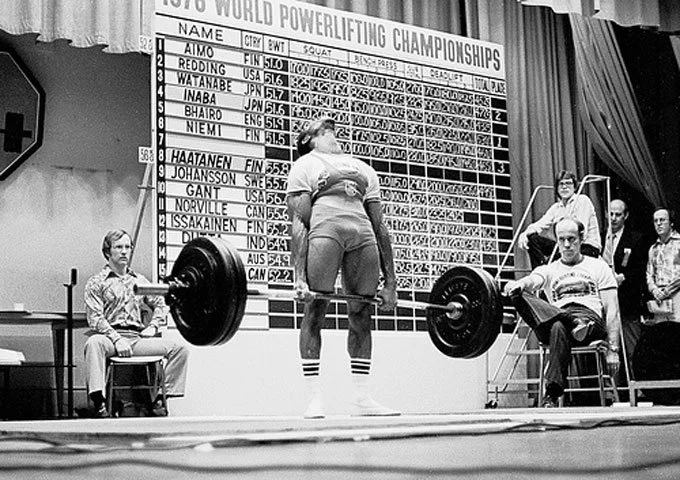
Lamar Gant finishing a deadlift still looking as far up and back as possible
As a coach, at times I've gotten away from eyeline emphasis, but whenever I spend a week doing it with clients, I universally notice a better look to their lifts; they notice a better feel. I remember when I was heavily involved in powerlifting training my clients and team, I would lick my finger and make a spit stain on the mirror in front of the rack. And when I trained multiple people, there would be multiple spots. “How's this look? Do you like it here?? Lower? Is it centered?” I did what we were supposed to do, and despite that I was licking and smudging a mirror in front of new clients, I really didn't think twice. Niko led that way, and damn it, I was going to be proud to be the way of the coach I was proud to have.
To wrap this up, I unfortunately don’t have the answer. There is no flag in the ground, except on eyeline being an important consideration and an empowering, crucial tool. I couldn’t in sound mind claim a specific way is right and these varying cases of wisdom and success are wrong. My recommendation is to start by looking straight ahead and locking into a spot. Bring all of your focus to it. If you are on your back bench pressing, then it’s a spot on the ceiling. You can make minor adjustments. If you pitch horizontally in the bottom of your deadlift or squat, picking a spot in between the angle of your top and bottom position might be ideal. This is where “pick a spot out on the ground 10 feet in front of you” might be the option. If you are unsure, search online for what others recommend for a particular lift. If you are a seasoned lifter, my only recommendation is to consider and experiment. Be deliberate and intentional, make sense of it, and feel what changes occur. All of these options are seen at the highest level, and they all have their own reasons for doing it. For this article, it is more a case of what you can do, not what you should.