
The Case for Raising Kids Who Belong in a Gym
I want you to picture two kids walking into a weight room for the first time as adults.
The first one has never touched a barbell, never done a pull-up, never been shown how to hinge at the hips or brace their core. They're 22, standing in the free weight section of a commercial gym, completely lost. They don't know where to start, they're afraid of looking stupid, and there's a good chance they turn around and walk right back out. Maybe they never come back.
The second one has been in and out of gyms since they were 8 years old. They know how to warm up. They know the difference between a squat and a deadlift. They know what their body can do, and just as important, they know what it feels like to push past what they thought it could do. Fitness isn't intimidating to this kid. It's just part of life, like brushing their teeth.
That second kid is who I'm trying to raise, both as a father and as a coach. And it's not really about the gym. It's about giving kids a skill set and a relationship with their own body that pays off for the rest of their lives.

Home school phys ed class
It's a Literacy, Not a Phase
We teach kids to read because literacy opens doors for the rest of their lives. I think physical literacy deserves the same treatment. Knowing how to move well, how to lift something heavy off the ground safely, how to push, pull, squat and carry - these are skills, and like any skill, they're best learned young, when the nervous system is still wiring itself and when there's no ego standing in the way of being a beginner.
Adults who never learned these things end up outsourcing their physical competence entirely. They hurt their back picking up a laundry basket wrong. They avoid the gym because they don't know what to do once they're in it. Meanwhile, a kid who grew up doing kettlebell swings and goblet squats walks into any gym on earth as a local. They know the language. They're comfortable there. And that comfort is exactly the thing that keeps adults showing up for a lifetime, instead of quitting after their New Year's resolution fizzles out in February.
The Myth That Won't Die
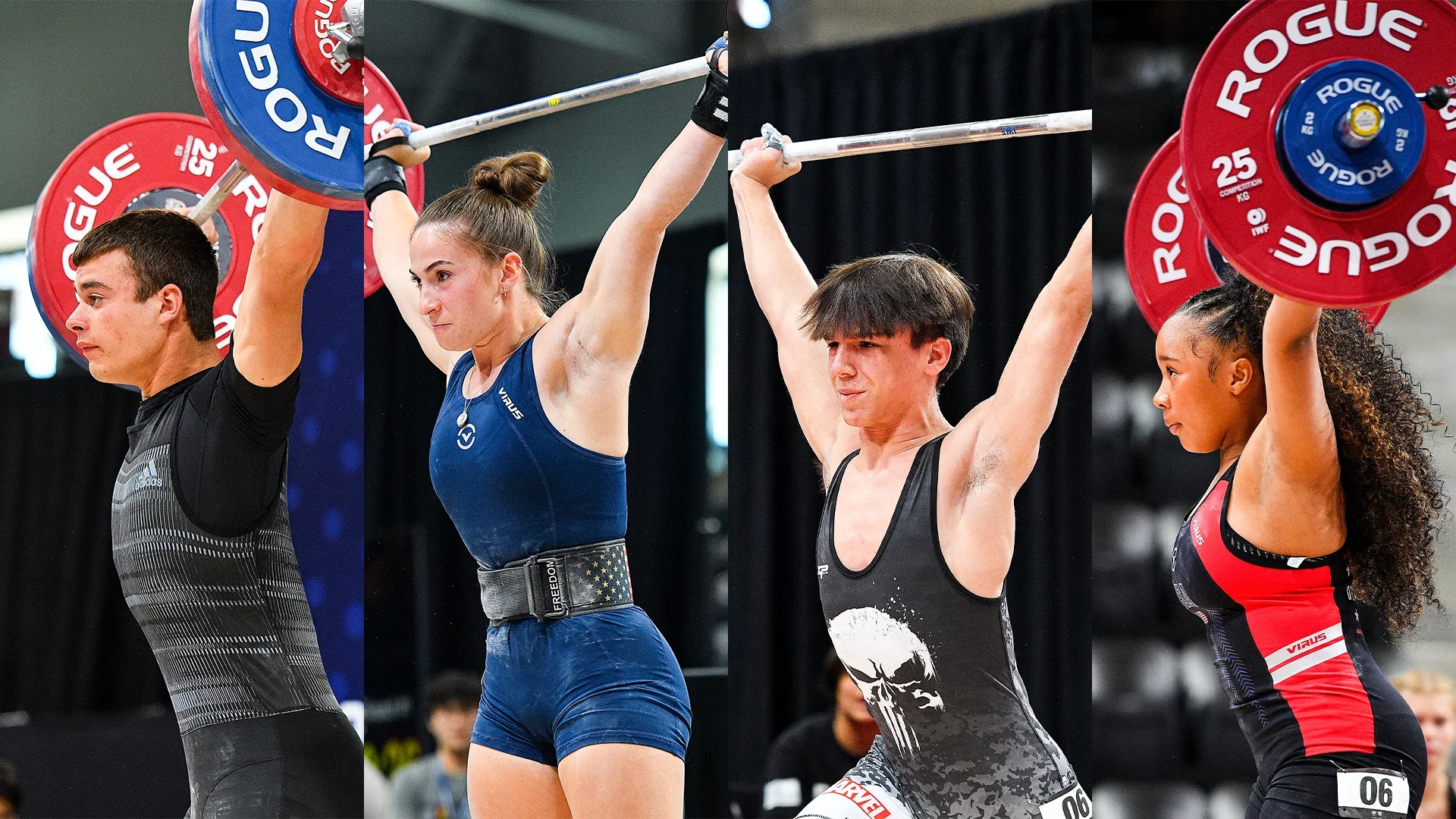
2025 Pan American Youth Championship competitors. Photo courtesy of https://www.usaweightlifting.org/
Here's where I have to get something off my chest, because it's a myth that just won't die: "Won't lifting weights stunt my kid's growth?"
No. It won't. This idea has been circulating since the 1970s, and it has never once held up under actual scientific scrutiny. It came from a handful of old case reports of growth plate injuries in unsupervised, poorly coached settings, and somewhere along the way that got twisted into a blanket rule that any resistance training is dangerous for kids. It's simply not true, and it's not just my opinion. The National Strength and Conditioning Association's youth resistance training position statement, along with the American Academy of Pediatrics and the American College of Sports Medicine, all agree there is no evidence that structured resistance training stunts growth or damages growth plates in children.1,2
If anything, the research points the other direction. Properly loaded training builds bone density during exactly the years when kids are laying down the skeletal foundation they'll carry the rest of their lives.1,3 Growth plates get injured from an uncontrolled amount of force applied all at once - a bad fall, a violent collision, a joint twisted the wrong way at speed. That's not what happens during a coached workout in the weight room. It's what happens on the trampoline, a fall from the monkey bars, or a hard collision on the football field.
And that brings me to my common sense argument, because sometimes you don't need a study to know something is true. Nobody tells their kid not to climb the tree in the backyard because it might stunt their growth, yet how is a pull up different from climbing a tree? Nobody keeps their kids out of contact sports for fear of height loss; there might be other concerns but I'd argue that stronger muscles help protect a young athlete from most every possible injury in competitive sports. A kettlebell swing is safer than a game of dodgeball. If we're not worried about the forces a kid's body absorbs jumping off the porch or wrestling with a sibling, we shouldn't be worried about a 10 year old learning how to deadlift.
There's also a much simpler mechanism at play that people rarely think about: kids who strength train tend to eat more and put on muscle mass, because the body demands fuel to recover and adapt. I have never seen a kid get smaller from training. I've seen them get bigger, stronger, and hungrier. That's not a coincidence. That's exactly how growth works.
I've put my money where my mouth is here. I've got five kids. Every single one of them has grown up in the gym. Literally. My oldest is 18 and I've owned Baltimore Kettlebell Club for 15 years. Not to mention our home gym, and their mother, who lifted throughout all of her pregnancies and wrote the book Prenatal Strength. None of them are stunted. Andrea has been participating in group training since she was 8 or 9 years old. She's tall, healthy, athletic, and finished high school 2 years early. If strength training stunted growth, my house would be the last place you'd want to look for evidence against it.
Strong Body, Sharp Mind
Now let's talk about what all this movement is doing upstairs, because the benefits go well beyond muscle.
Here's something a lot of parents don't expect: the same training that builds a kid's body also sharpens what's going on in their head. Studies looking at school-age kids keep finding the same pattern - kids who move more and kids who are more physically fit do better in the classroom.4 One of the most convincing bodies of evidence comes from a set of long-running trials called FITKids, which followed kids over years and found that regular physical activity translated into real gains in cognitive performance, everything from test scores to how their brains were actually functioning.5 Even a single workout can shift how a kid thinks in the moment - researchers have found that a single bout of exercise can boost a kid's creative problem solving, which happens to be a big piece of what "doing well in school" actually requires.4
This tracks with everything I've seen coaching kids for over a decade. The kids who train regularly show up more focused, more disciplined, and more willing to grind through something hard, whether that's a tough set of squats or a tough math assignment. Training teaches kids what effort actually feels like, and that carries over into the classroom whether anyone planned it that way or not.
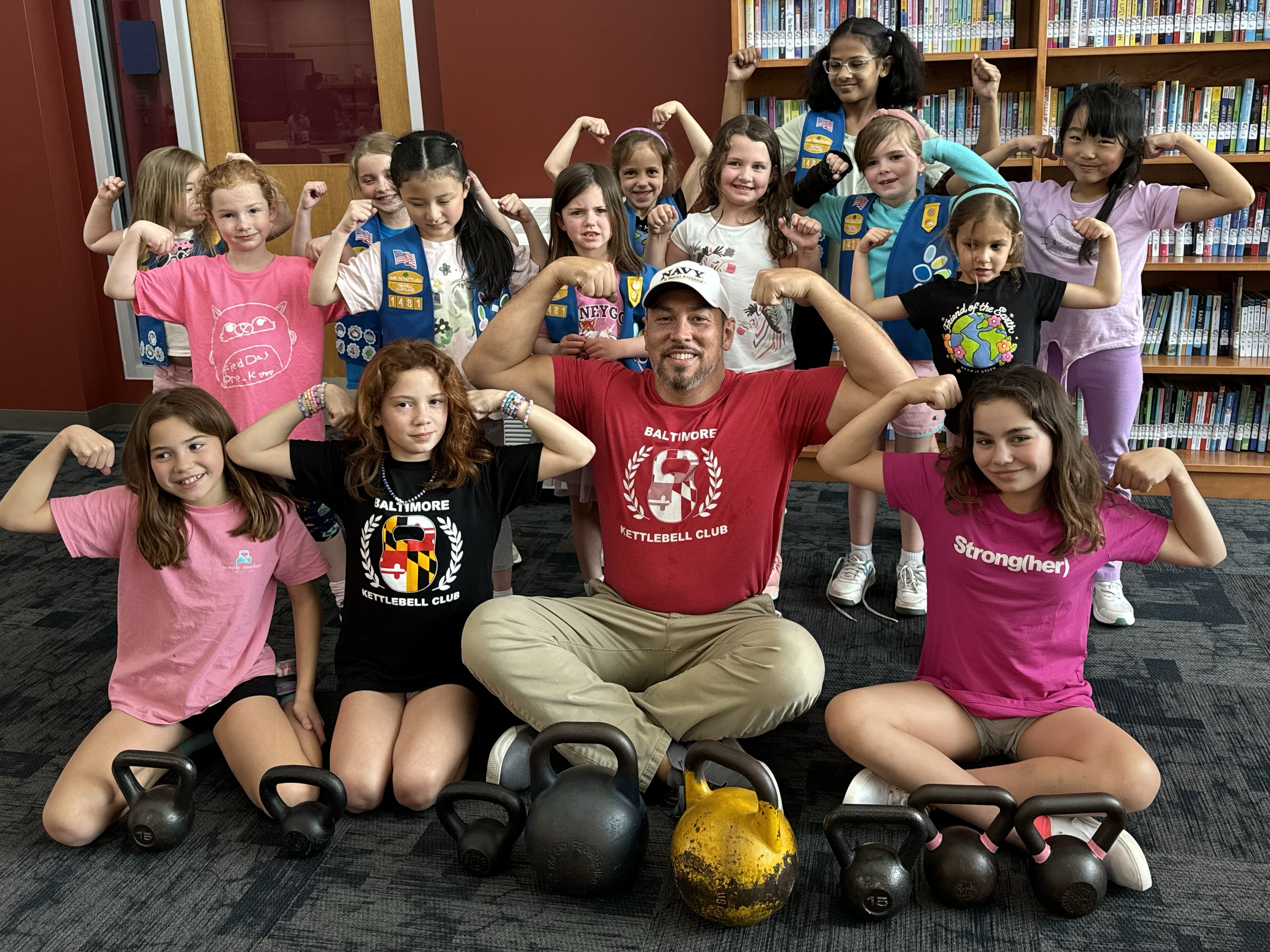
My 3 youngest daughters and I, with the girl scouts.
The Psychological Payoff
Then there's the part of this that matters just as much as any grade or growth spurt: how kids feel about themselves.
Research specifically looking at resistance training in youth has found real improvements in self-esteem, self-efficacy, and physical self-perception - in plain language, kids feel more capable and more confident in their own skin.6 One study on adolescents found that twelve weeks of resistance training significantly increased strength, dropped body fat, and boosted self-esteem in both overweight and normal-weight teenagers.7 Another found that girls who strength trained rated their own bodies as more attractive and reported greater satisfaction with their physical appearance compared to girls who didn't train, and this happened even before any major physical changes had taken place.7 In other words, the confidence often shows up before the six-pack does. It's not vanity. It's competence. A kid who knows they can lift something heavy, hold a plank, or do a strict pull-up carries themselves differently, because they've proven something to themselves with their own two hands.
I've watched this play out dozens of times over the years. A socially withdrawn kid comes in nervous, unsure of themselves, afraid of being laughed at. Within weeks they're smiling more, standing taller, talking to the other kids instead of hiding from them. Some of them go on to help run warm-ups for the younger kids once they've been around long enough. Nobody hands them that confidence. They build it themselves, one rep and one class at a time. A lot of the kids I worked with years ago are in their early twenties now, and plenty of them are still total gym rats - which beats the alternative of spending every night at the bar instead. That's the psychological benefit of strength training in a nutshell. It's not a slogan on a poster. I've watched it happen with my own eyes over and over again.
Andrea's Turn
Which brings me to the news I actually sat down to write this article to share.
Andrea started in our kids classes as a little girl and never really left. She grew up in this gym, swinging bells that were nearly as big as she was, and she kept showing up through the awkward years, the busy years, and the years when most teenagers spend all of their time on their phone. In 2024, at sixteen years old, she stepped on a competition platform for the first time and won the novice middleweight division (150-185lb class) at the Charm City Strongwoman contest. Last month, she earned her SFG kettlebell instructor certification, putting her credentials right alongside mom and dad.
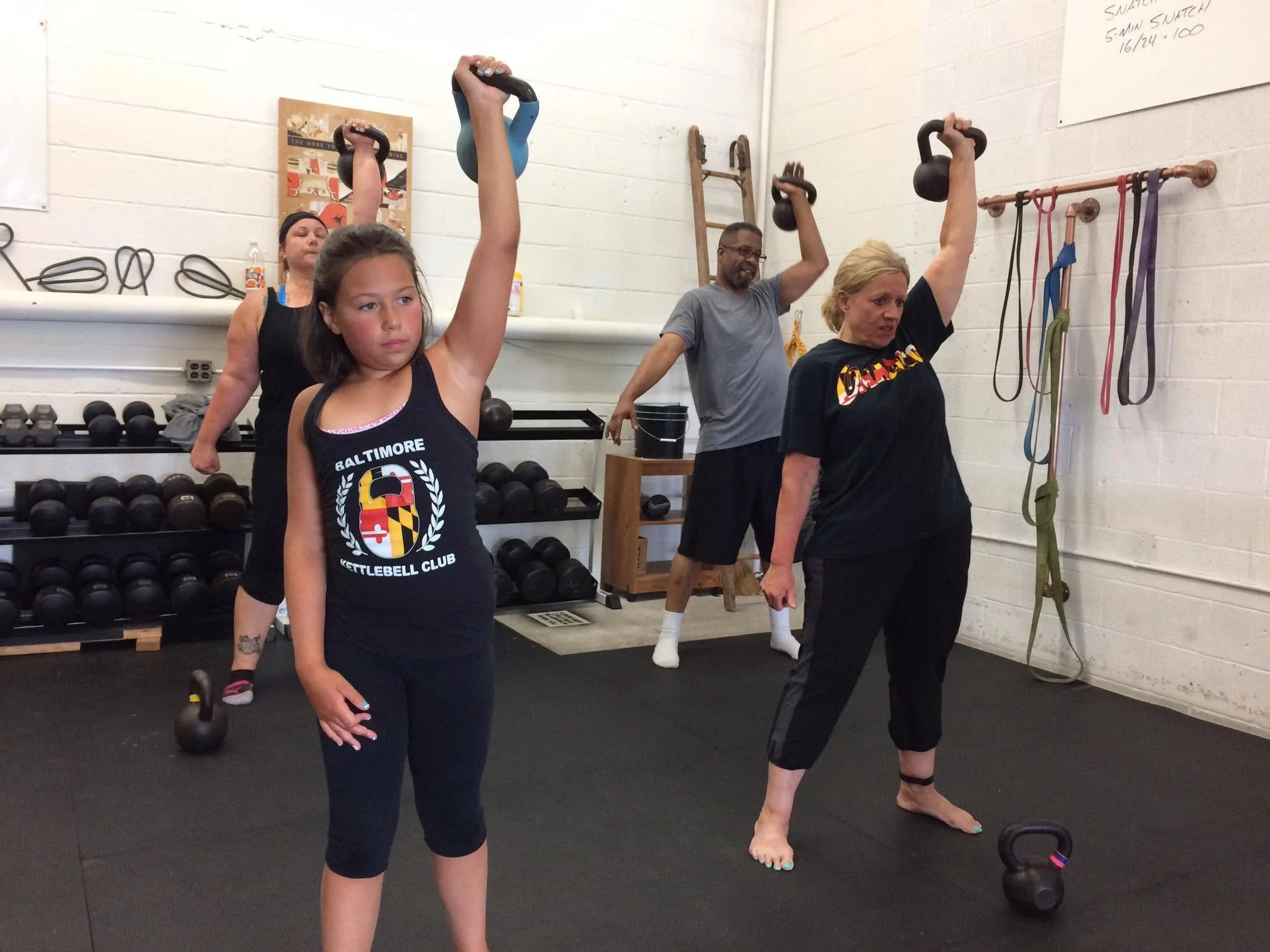
Andrea, 9, taking kettlebell class with her 2nd grade teacher Ms. Denike.
She's not just a success story I like to tell. She's about to become a bigger part of how we run this place. Andrea will be taking on a larger coaching role at Baltimore Kettlebell Club, and we're planning to expand the Little Lifters program with her at the helm. There's something powerful about a teenager teaching other kids how to move. She's lived every stage of this that we're asking these kids to go through, and that kind of credibility can't be faked.
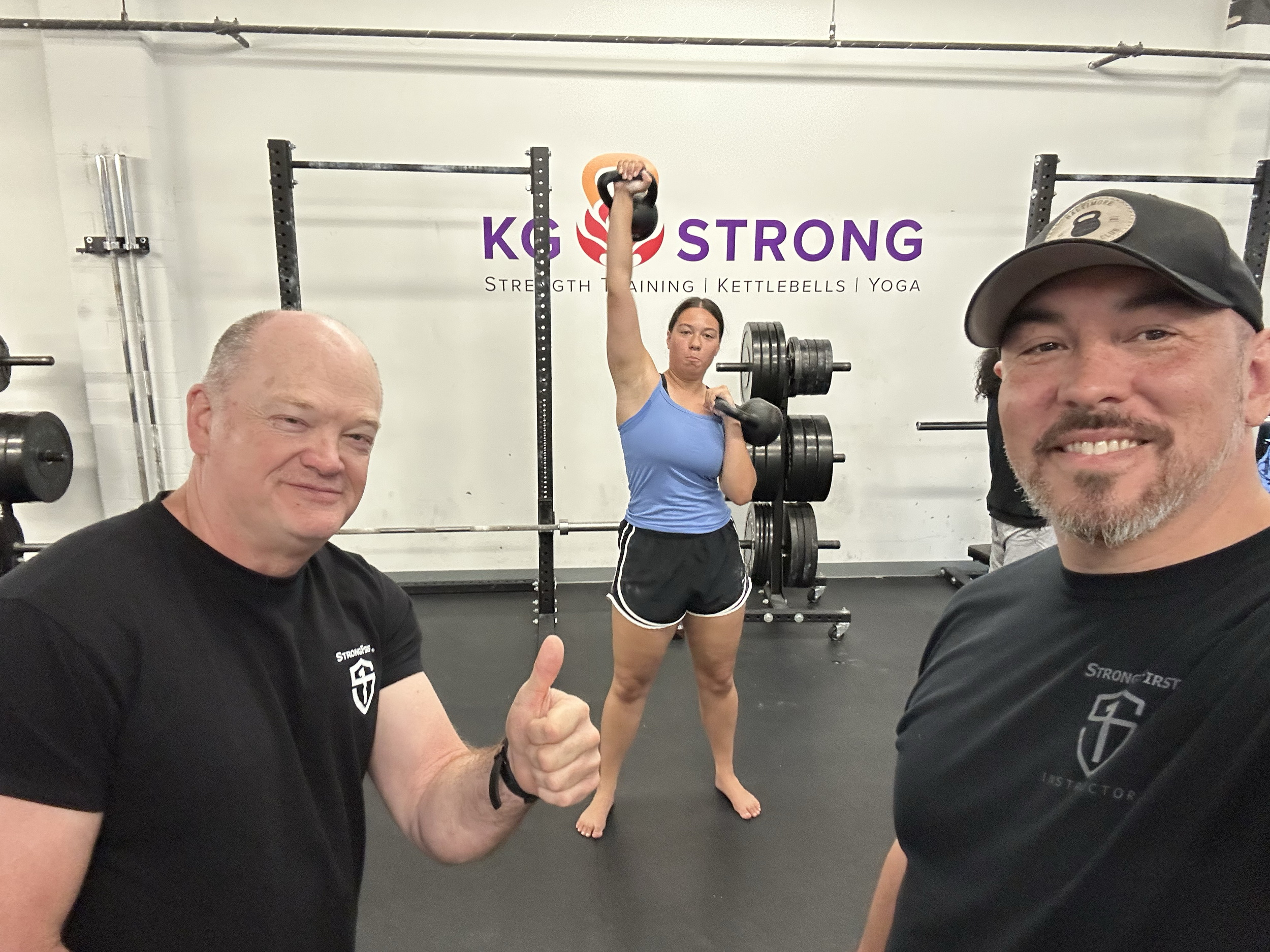
Andrea, 18, completing the “grad workout” at the SFG kettlebell instructor certification.
The Bottom Line
I'm not trying to raise powerlifters (unless that's the direction they want to take it). I'm trying to raise kids who are never afraid to walk into a gym, who understand their own bodies, who know effort is something you can build, not something you're born with, and who carry that confidence into every other room they walk into for the rest of their lives - the classroom, the ball field, the job interview, the delivery room, wherever life takes them.
The science backs up why kids should lift weights. Common sense backs it up. And frankly, my own five kids back it up every single day, running around this gym stronger, healthier, and about a foot taller than the myth says they should be.
Live Strong,
-Dan Cenidoza
References
Faigenbaum, A.D., et al. "Youth Resistance Training: Updated Position Statement Paper from the National Strength and Conditioning Association." Journal of Strength and Conditioning Research, and the 2014 International Consensus Position Statement on youth resistance training, British Journal of Sports Medicine, 48(7), 498–505.
Weightlifting for Children and Adolescents: A Narrative Review. PMC, National Institutes of Health.
Lloyd, R.S., Faigenbaum, A.D., Stone, M.H., et al. Position statement on youth resistance training: The 2014 International Consensus. British Journal of Sports Medicine.
Physical Activity and Academic Performance in School-Age Children: A Systematic Review. Sustainability, MDPI, 2023.
FITKids randomized controlled trials, cited in Physical Activity, Fitness, and Cognitive Function in Children and Adolescents, IntechOpen.
Collins, H., Booth, J.N., Duncan, A., Fawkner, S., Niven, A. "The Effect of Resistance Training Interventions on 'The Self' in Youth: A Systematic Review and Meta-analysis." Sports Medicine - Open, 2019.
Strength Training For Children and Adolescents: Benefits, Risks, and Practical Recommendations. StrengthLog, referencing multiple peer-reviewed adolescent resistance training studies.