
20 Years as a Certified Kettlebell Instructor
This month marks two decades since I walked into a room in St. Paul, Minnesota, full of strangers swinging cast iron over their heads. I didn't know it at the time, but that weekend in September of 2006 was going to reroute the rest of my life.
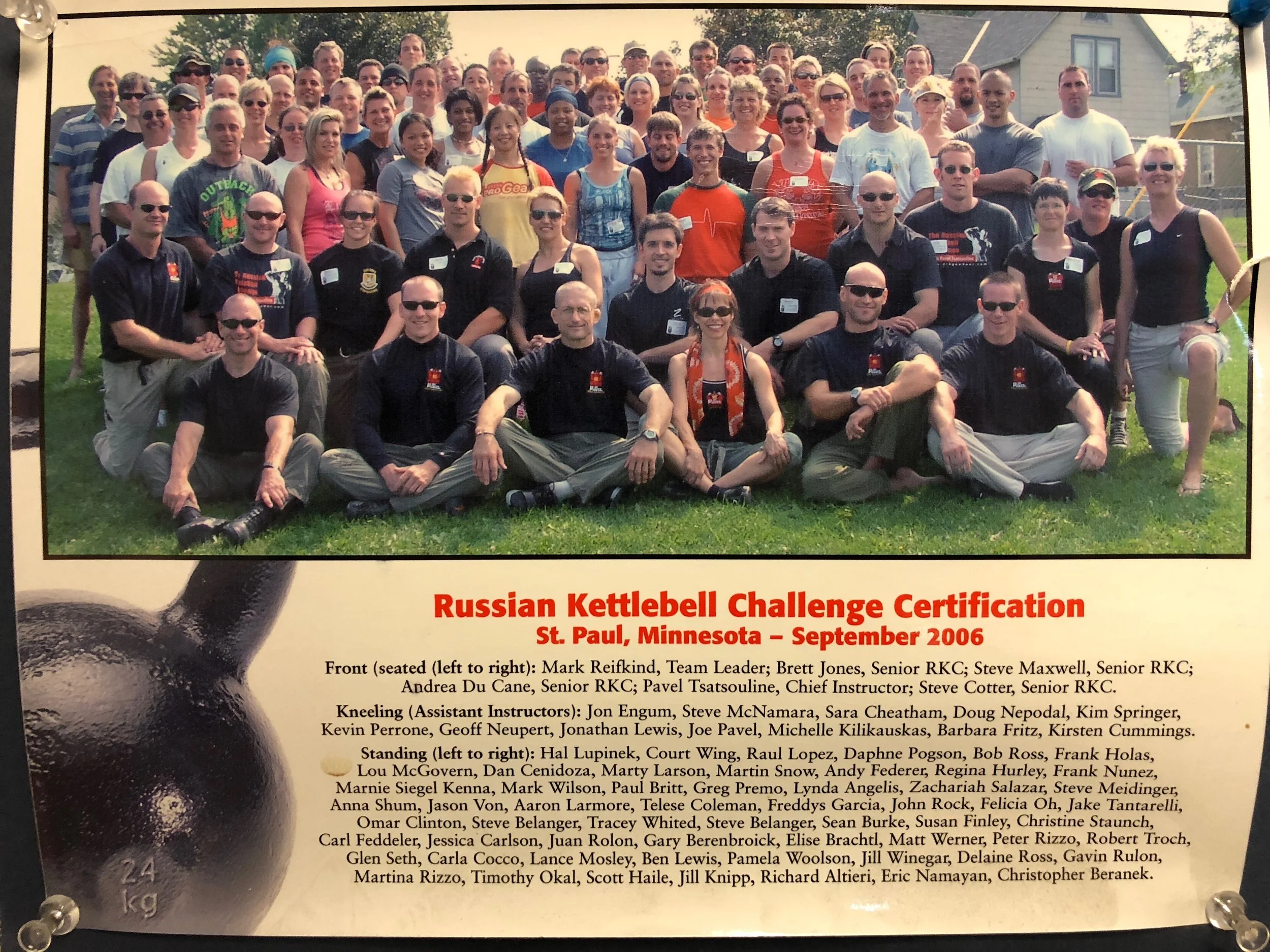
Sept. 2006 RKC in St. Paul
How It Started
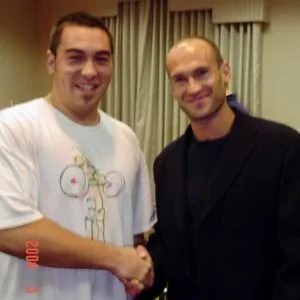
Arnold Classic 2004
I certified through the RKC, the Russian Kettlebell Challenge, Pavel Tsatsouline's original instructor program, in 2006. I was young, I was strong, and I thought I understood training. The RKC humbled me in the first 5 minutes (back then the snatch test came first on day one) and it handed me a tool I've never put down since.
Here's what nobody tells you when you're freshly certified: life doesn't slow down to let you build a career. The year after I got certified, we had our first child. Over the next six years, that became the pattern of my life. Either I was recertifying, or we were having another kid. Sometimes both were happening at once. I was flying out to certifications with a baby at home, training for strength tests on no sleep, and trying to build a business and a family at the same time. The snatch clock doesn't care that you were up at 3 a.m.
I wouldn't trade a single sleepless year of it. But it wasn't easy to be a young father and a young business owner chasing a standard that doesn't bend for your circumstances.
From RKC to StrongFirst
In 2011, I left my day job and founded Baltimore Kettlebell Club. In 2012, Pavel left the RKC and founded StrongFirst, and I went with him. The RKC gave me my foundation, but StrongFirst is where the system matured: more rigorous, more precise, and built around an idea that still runs my whole philosophy, being a student of strength.
Since that first certification my CK-FMS, SFG, SFG2, and the StrongFirst Bodyweight certification (SFB). I've also gone back to assist at certifications, which is a different kind of pressure. You're watching other people's tests instead of taking your own, and you learn a lot being on the other side of it. In between, I've kept everything current with video recerts. All told, it's been a steady mix of new certifications, assisting, and recertifying for twenty years.
In 2018 Baltimore Kettlebell Club became a StrongFirst Accredited Gym, which means we meet StrongFirst's standard for how the system is actually taught, not just performed for a test. I've lost count of how many people I've trained to become an SFG, but at the time of this writing we have 8 StrongFirst instructors at BKC. My daughter was certified this year, and my wife Jessica and brother David are former SFGs. That's gotta be the largest collection in the world of SFG instructors with the last name Cenidoza! ;-)
Why the Kettlebell Is the Best Tool for Training the Masses
I've trained beginners in their seventies who had never touched a weight, and I've trained competitive athletes who needed another gear. The kettlebell serves both in the same session, with the same movements, at different loads. Most tools force you to specialize. The kettlebell scales.

It's convenient like nothing else. One kettlebell and six feet of floor space gets you a complete strength and conditioning system. Although nice to have, there’s no need for rack of dumbbells climbing in five-pound increments, no need for squat rack, no need for machines. A swing, a get-up, a clean, a press, a squat, a snatch: that's the whole curriculum, and it fits in a garage, a corner of your living room, or the truck of your car to take with you on vacation.
It trains the whole body, honestly. A swing isn't a hip hinge in isolation. It's grip, lats, glutes, hamstrings, and a braced core all firing on the same rep, at speed, under load. The get-up teaches your shoulder to be strong in every position a shoulder can be in. There's no muscle isolation here, because life doesn't isolate muscles either. You bend, you carry, you lift overhead, you catch yourself. That's what translates to a 78-year-old getting up off the floor unassisted or a 14-year-old getting stronger for their sport. And because the swing and snatch are ballistic, you're building strength and conditioning in the same workout.
It's fun, and fun is functional. I've watched grandmothers get genuinely excited about their first heavier bell. There's something primal and satisfying about getting stronger. It doesn't feel like punishment. People show up and they stay consistent, and consistency is what produces results over years and decades.
And none of it works without a good instructor. A kettlebell in untrained hands is a liability: a swing with a rounded back, a snatch caught wrong, a press that turns into a shoulder injury waiting to happen. The tool is only as safe and effective as the coach teaching it. That's why certifications like SFG exist, and it's why I've spent twenty years making sure I stay certified.
What It Takes to Hold These Certifications
People see the StrongFirst shield on the wall and assume it was earned once and it's theirs forever. It isn't, and that's the point.
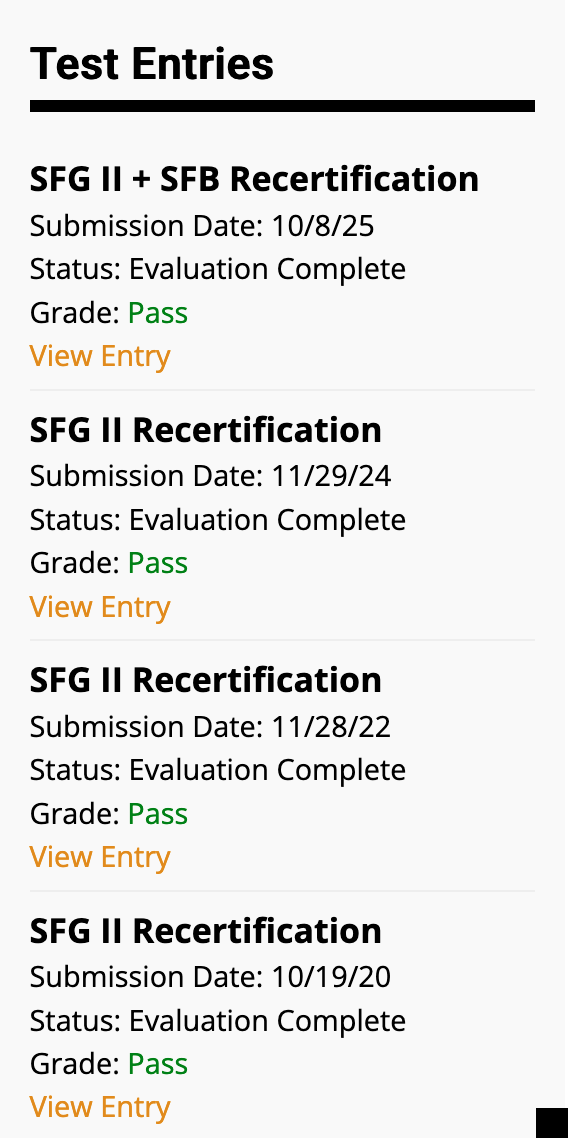
Video Recert Entries
SFG I is a three-day event that tests the six foundational lifts (swing, get-up, clean, press, squat, snatch), your teaching ability, and your judgment, and it finishes with a timed snatch test. A meaningful share of prepared candidates don't pass. That's on purpose, because the standard has to mean something.
SFG II requires a current SFG I and raises the bar: double kettlebell work, a heavier military press strength standard (roughly half bodyweight for men, a third for women), and a full re-test of every Level I skill with tighter tolerances. You're proving you can still do it, and that you can teach it safely under a Master Instructor's eye.
SFB takes the same standard and strips away the equipment. The strength triad is a push, a pull, and a squat: the one-arm push-up, the tactical pull-up, and the pistol squat, all with strict technique and standards scaled by age and sex. No kettlebell to hide behind.
SFL is the StrongFirst Lifter certification, the barbell counterpart to the SFG. It's not one I currently hold, but it's part of how we round out the system at BKC, and we have two SFL instructors on our team. The SFL covers the powerlifts (back squat, bench press, and deadlift) plus high-value accessory lifts like the front squat, Zercher squat, good morning, and military press. Candidates face a strength test on the powerlifts and a technique test on the accessory lifts, and StrongFirst expects real preparation before you show up. It's another reminder that StrongFirst is a school of strength, not about any one piece of equipment.
And none of it is one and done. Every certification expires, and to keep them you recertify on a regular cycle by retesting, submitting video proof of the standard, or assisting at an event. We call it "keeping the blade sharp" or “polishing the chrome”. Either way, the certification on the wall isn't a trophy from 2006. It's current, because I tested for it recently and I'll test for it again. I don't get to coach people toward a standard I'm not willing to keep meeting myself.
Twenty Years In
It doesn't read like a straight line. It reads like a life: kids, certifications, a business, more kids, more certifications. Twenty years later I'm still swinging the same tool I picked up in that room in St. Paul, still recertifying, still a student.
If you've ever wondered why we take the kettlebell as seriously as we do at Baltimore Kettlebell Club, this is why. It's twenty years of proof that it works if you respect it, and if the person teaching it never stops being tested on it too.
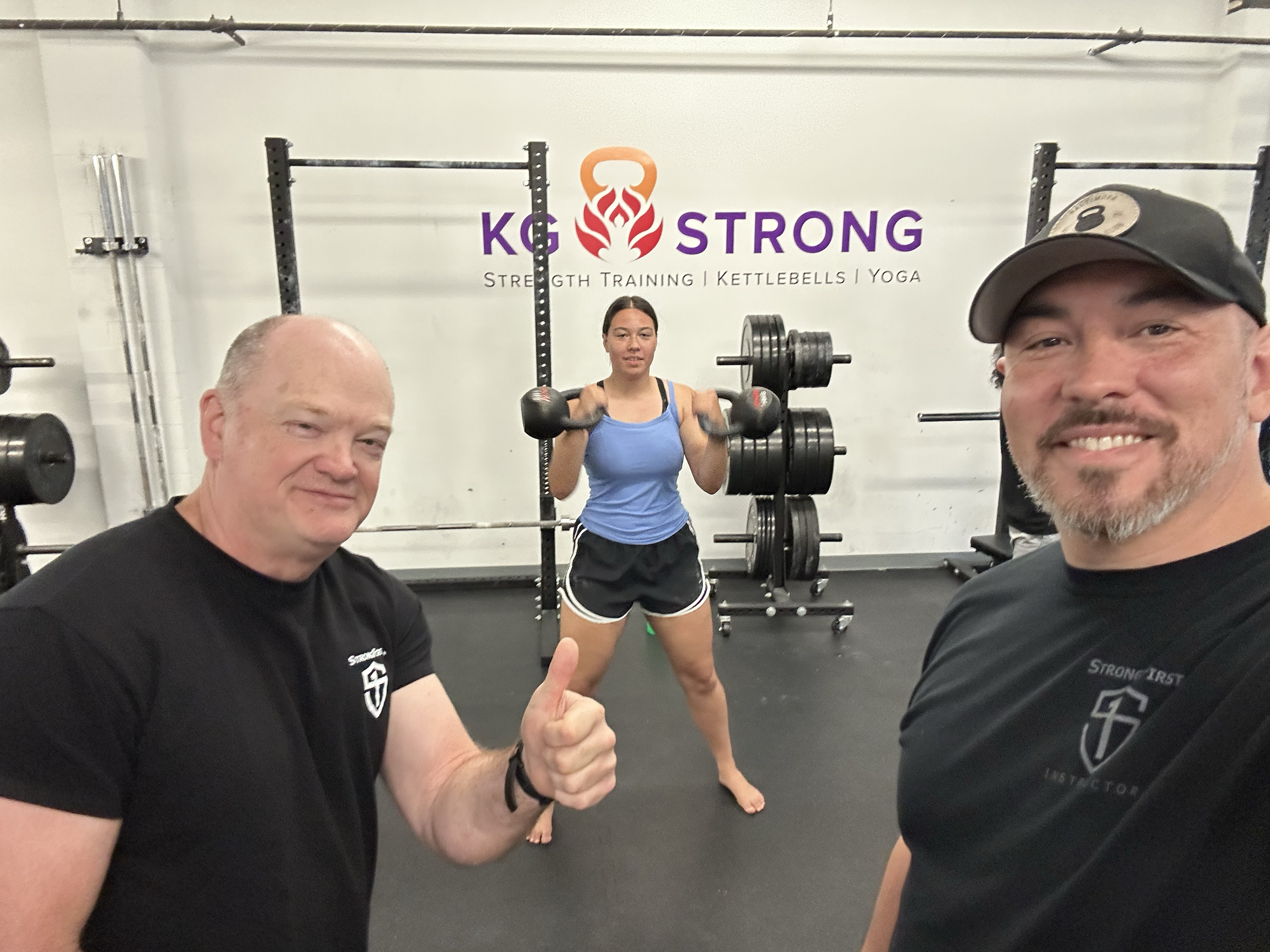
My daughter Andrea Cenidoza (18) during the grad workout at the May 2026 Philly SFG, along with Master Instructor Jon Engum and I.